
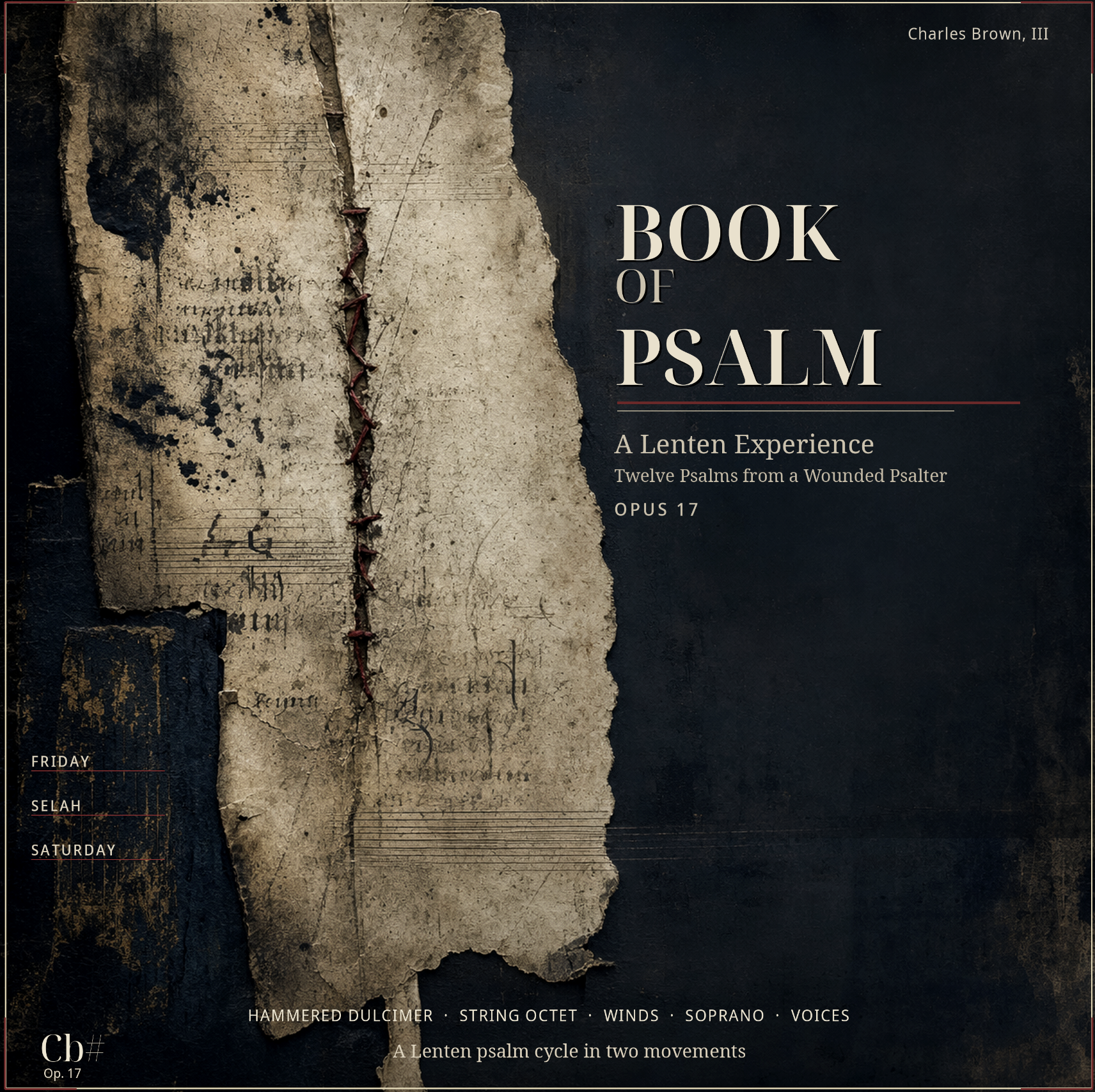
A Lenten Experience
Twelve Psalms from a Wounded Psalter
RELEASE: Lent 2028
DESCRIPTION:
The ancient collection is called the Book of Psalms — plural, an anthology of one hundred fifty voices across centuries. This evening is called Book of Psalm — singular, deliberately.
What the audience will hear in Lent 2028 is not a sampler. It is one sustained prayer that took nearly fifty years to recognize as such. Fragments composed in 1978, 1990, 1992, 2016 — each written in isolation, each in a different season of this composer’s life — converged, without his knowing it, toward a single Lenten purpose. The singular form is a theological statement: these twelve psalm settings and the works surrounding them are one utterance. One cry. One wounded book.
The dropping of the ‘s’ is not an oversight. It is the thesis.
—————————-
Book of Psalm is structured as a Lenten experience in two movements: Friday and Saturday. There is no Sunday. The audience is not promised resurrection; the audience is asked to remain inside the silence between the cross and the empty tomb — the day the disciples did not know what was coming.
Friday is the day of the cross. Friday is shorter, swifter, more brutal. The audience hears the psalms as text. They observe the descent. They are present at the cross but not in it.
Saturday is the longer, more desolate day. Saturday is the waiting day — time stretches, grief has to be lived with, hope is not yet possible. Across Saturday, the audience is asked to move: from witness, to participant, to recipient of a sending. By the evening’s end, the audience is no longer the audience. They are part of the work.
Friday witnesses; Saturday participates.
The asymmetry of the two halves mirrors the asymmetry of the Triduum itself. Good Friday’s liturgy is shorter than the Easter Vigil for a reason. The work was not engineered to do this. The work discovered it was already doing this.
The twelve psalms that anchor the cycle have been chosen for what they ask, not what they answer. Psalm 22 — the forsaken cry that Christ quoted from the cross — sits at Friday’s close. Psalm 88 — the only psalm in the entire Psalter that ends without a turn toward hope — sits as Friday’s penultimate moment, in a setting where the hammered dulcimer is structurally absent. The dulcimer’s silence mirrors the soprano’s absence. Aloneness is architectural, not merely textual. The piece does not conclude. It stops.
Saturday opens with Rumination — an instrumental for hammered dulcimer and string octet, originally composed for hammered dulcimer and string quartet and premiered at Wheaton Bible Church on May 3, 2026. The 2026 string octet revision was written specifically as the entry into Saturday: the question Holy Saturday asks, asked without words. The instrument turns the question over. The strings answer with more questions. Language is not yet possible. Rumination is dual-listed in this composer’s catalog as Opus 16, No. 1 — entering Opus 17 as a re-scored psalm setting under the precedent established by Bach, Handel, and Vivaldi, who frequently allowed a single work to serve multiple opus contexts.
Saturday’s most theologically ambitious setting is Psalm 42/43 with Gethsemane — a hybrid in which the psalmist’s three-time refrain, “Why are you cast down, O my soul?” is met by a new lyric drawn from the garden. Matthew 26:38 — “My soul is overwhelmed to the point of death” — is itself a quotation of Psalm 42 in Christ’s own voice. The hybrid setting makes that quotation audible: the psalmist’s cry meets Christ’s voluntary surrender. The Old Testament’s question and the New Testament’s answer are sung as one.
After the final text-driven psalm, the audience crosses a threshold. They are no longer witnesses. They are voices. Two congregational choruses — drawn from this composer’s catalog and attributed in this work to Psalm 32 and Psalm 121 — invite the sanctuary to sing. The musicians then exit. This composer thanks the audience and asks that there be no applause. And the evening ends with a sending.
THE SONIC FRAME:
As the audience is seated, the opening movement of Henryk Górecki’s Symphony No. 3 (Symphony of Sorrowful Songs) (1976) builds in slow, inexorable canon — strings ascending toward something. It will stop before the soprano enters. The human voice will not arrive until this composer steps to the dulcimer.
What Górecki begins, this evening completes.
At the close of the evening, the same Górecki movement returns. The audience exits inside the same sonic world they entered. The frame closes.
INSTRUMENTATION
– Composer · Vocalist · Hammered Dulcimer (Charles Brown, III)
– String Octet (2 Violin I · 2 Violin II · 2 Viola · 2 Cello)
– Guest Soprano
– Guest Winds (Flute, English Horn · Bass Clarinet, Bassoon)
– Archival recordings: 1978 and 1991, presented with 2026 AI-augmented orchestration
A LIFETIME’S SYNTHESIS
This composer’s sacred output reaches back to 1978. Driving Nails (1990, recorded 1991) was the first sustained encounter with Lenten weight in a body of work that, in retrospect, had been writing toward Lent for decades without naming it. Sign of Sending (1978) was the youngest voice in the catalog, composed the year before this composer left for the Cincinnati Conservatory of Music. Both works are present in Book of Psalm — not as quotations, not as tributes, but as the works themselves, woven into the architecture of the Lenten evening they had been waiting fifty years to enter.
What this composer did not realize, until the work’s architecture became fully visible in early 2026, was that he had been writing Book of Psalm his entire compositional life. The work was not commissioned. The work was recognized.
This is the capstone work of a fifty-year sacred catalog.
ARTWORK DESCRIPTION:
Coming Soon — graphic designer Heidi Steiner is at work on the cover art for Book of Psalm, Opus 17. Heidi has designed the album covers for every opus in this composer’s catalog. Her artwork for Book of Psalm will be released alongside her own description and reflection on the design process.
This page will continue to evolve through Lent 2028 as the composition reaches completion and the full architecture of the evening becomes ready to share.